Options
Options are found under File -> Options -> General settings.
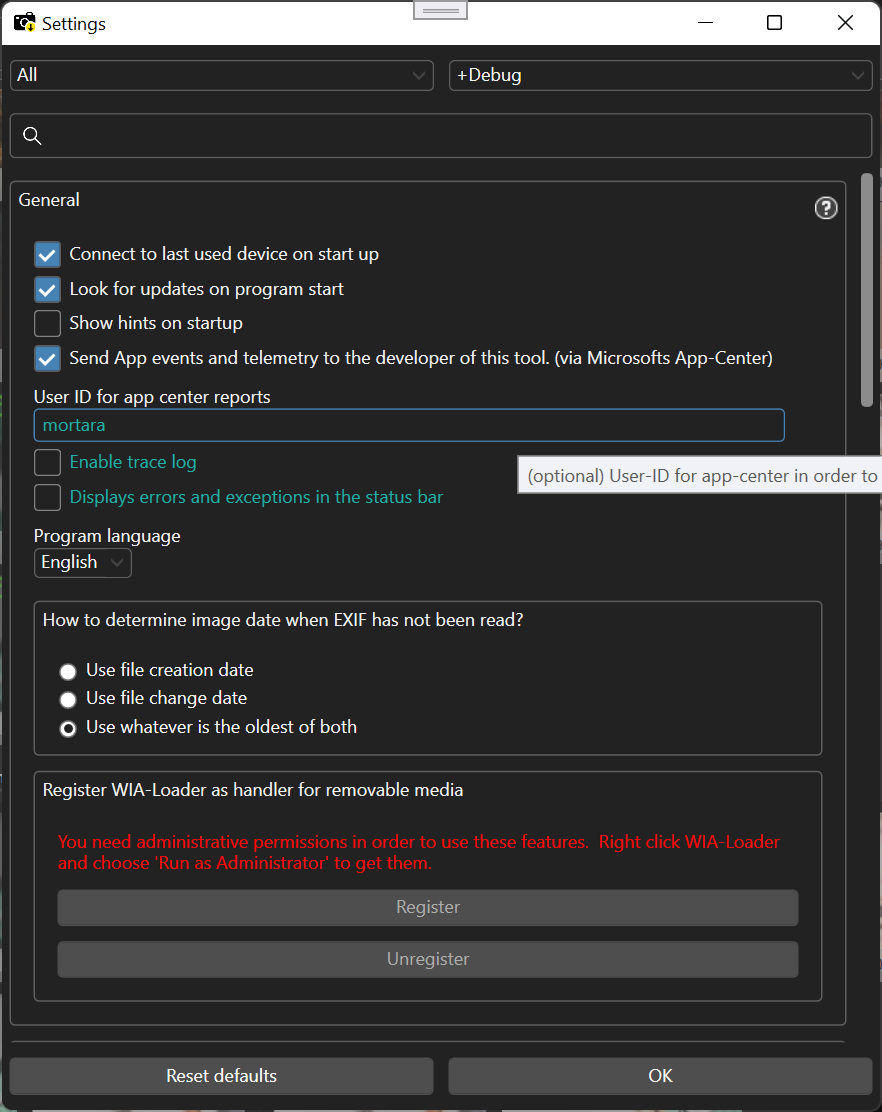
General
- Connect to last used source on program start
When active, WIA-Loader automatically connects to the last used picture source on
startup, provided it is still available.
- Look for updates on program start
When active, WIA-Loader automatically checks online after startup whether a newer
version of the program is available, and shows a message if so.
- Show tips and tricks on program start
- Send app events to the developer of this program
When this option is enabled, WIA-Loader sends telemetry data to me via the Microsoft
App Center. I use this to improve the program and fix bugs. No personal data is
transmitted!
- Enable trace mode (debug)
When active, WIA-Loader writes more information into its log file.
Changes to this setting only take effect after restarting WIA-Loader!
- Register WIA-Loader as handler for removable media
This button registers WIA-Loader as a handler for removable media. This lets
WIA-Loader, for example, start automatically when a flash card with photos on it is
connected to the computer.
- Report bugs
This menu item in the main window lets you send a bug report directly to me at any
time, in case something doesn't work as expected.
Paths / Directories
The settings in this category are described here.
Devices and sources
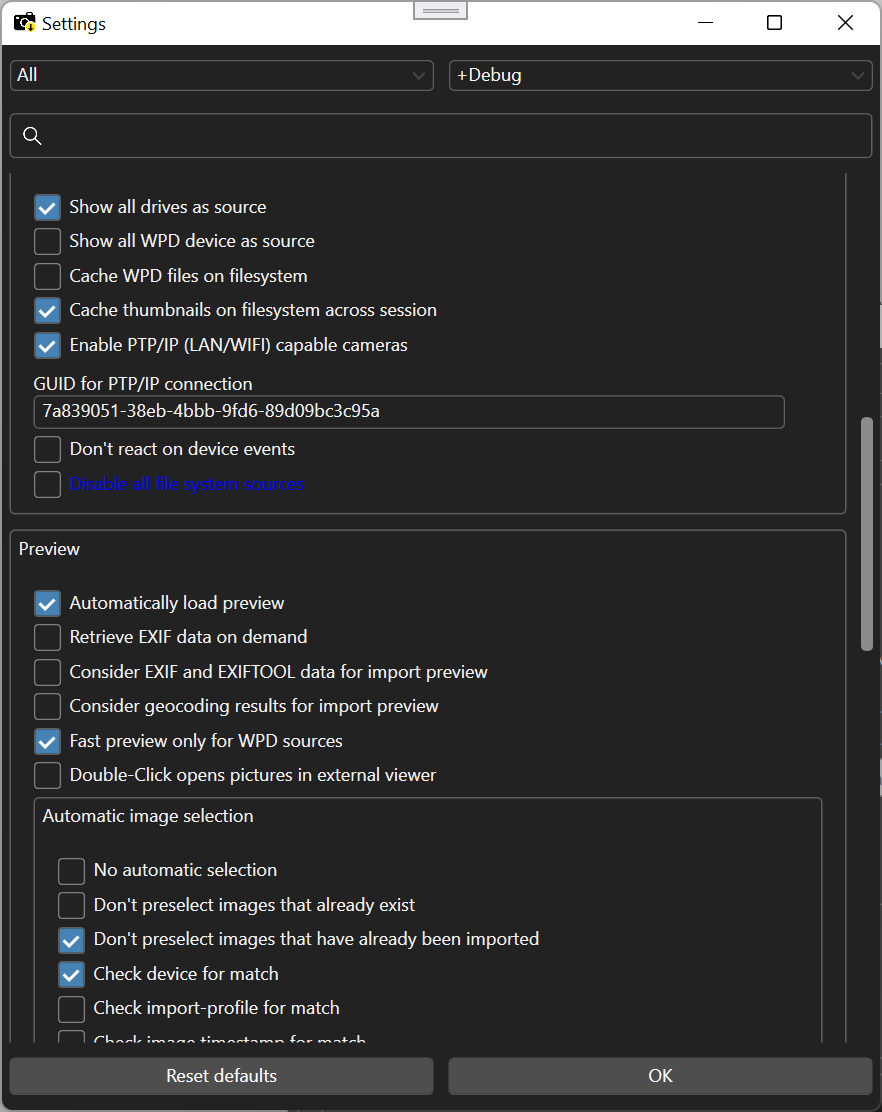
- Show all drives as source
Normally, WIA-Loader only shows drives as a picture source if they contain a flash
card with pictures from a digital camera. If you enable this option, all other Windows
drives and network drives are offered as well.
- Automatically load preview
When active, WIA-Loader automatically loads the picture preview once a connection to a
picture source has been established.
- Include PTP/IP capable cameras
More about PTP/IP can be found here.
Preview
- Fast preview only
WIA-Loader prefers to use the preview images embedded in the pictures themselves. If a
picture doesn't contain one, WIA-Loader generates one. Since this can take a while, this
option lets you prevent that. When active, only preview images are shown if the picture
file itself contains one.
- Consider EXIF and EXIFTOOL data for import preview
When active, EXIF and EXIFTOOL variables that may be used are also evaluated in the
import preview. This does, however, slow down building the import preview a bit.
- Consider geocoding results for import preview
When active, the variable <TRACK> that may be used is also evaluated in the import
preview. This does, however, slow down building the import preview a bit.
- Group base folders in import preview
When active, and the selected import profile has multiple 'SaveAs' steps, the target
folders in the preview are merged if they are the same or overlap.
- Don't preselect any images
When active, no images are automatically selected for import.
- Don't preselect images that already exist
When active, images that already exist at the target location are not automatically
selected for import. This check only tests whether a file with the same name already
exists at the target location - it does not further check whether the image is actually
the same.
- Don't preselect images that have already been imported
This option differs from the previous one in that it uses an internal WIA-Loader database
to determine whether an image has already been imported or not. More about this database
further down on this page.
By default, it is enough for WIA-Loader if any file with the same name has already been
imported - WIA-Loader will then no longer automatically select such files for import.
- Include source. In addition to the file name, the picture source is now also
taken into account for the comparison. This is necessary if, for example, you use
several cameras that give pictures the same names.
- Include import profile. For the automatic selection, the currently selected
import profile is now also compared against the contents of the database. This is
useful if you import your pictures with several profiles one after another to
different destinations.
Import
- Default format of date variables
Specifies the output format of <DATE> and <PDATE>.
More about this here.
- Default format of time variables
Specifies the output format of <TIME> and <PTIME>.
More about this here.
- Default format of numeric variables
Specifies the output format of numeric variables like <NUM> and <NUMF>.
More about this here.
- Check target drive before import
When active, WIA-Loader checks before importing pictures whether there is enough
free space on the target drive and whether WIA-Loader is allowed to write pictures
to it, and whether these pictures can subsequently be read again as well.
Devices
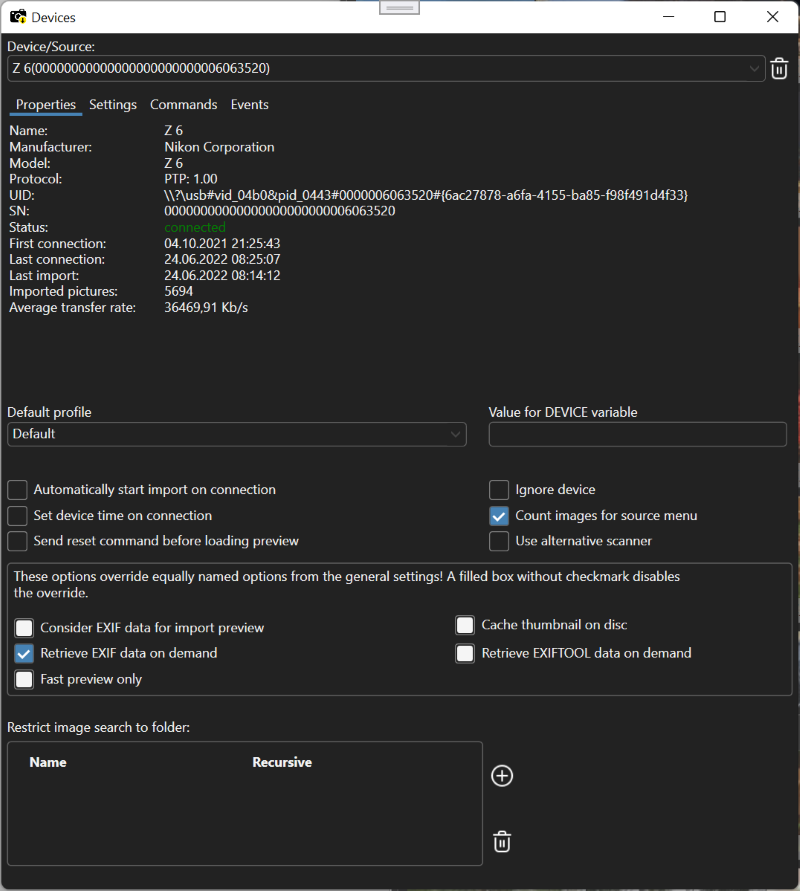
WIA-Loader keeps a list of all 'devices' it has connected to. These are primarily digital
cameras, scanners, webcams, etc.; flash card drives can occasionally show up here too.
In addition to some statistical information, there are also a few settings you can make here.
For example, you can tell WIA-Loader to set the internal clock of a connected camera as soon as
it is connected to the computer.
Imported pictures
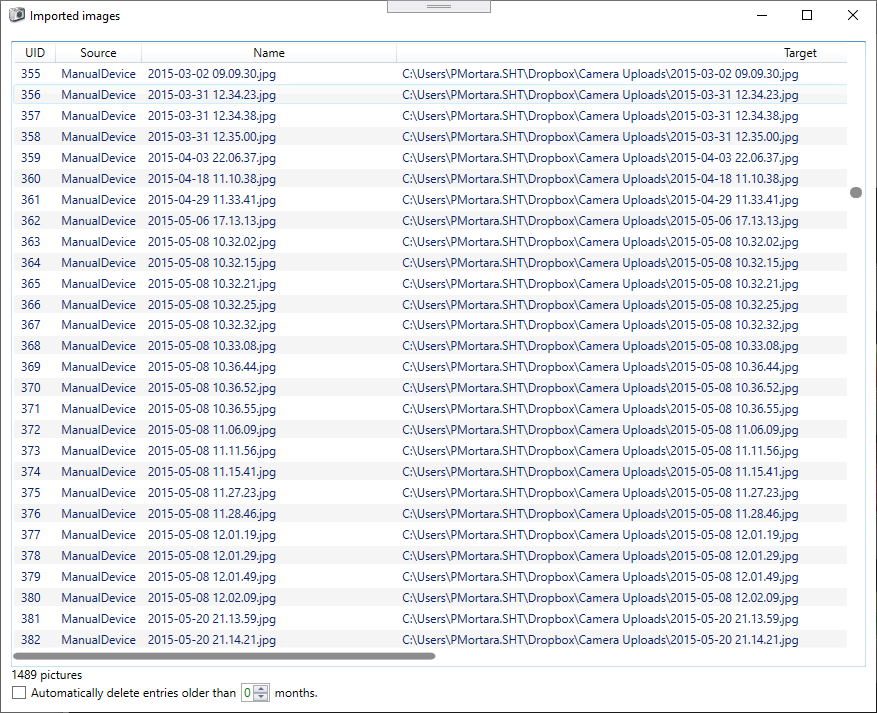
WIA-Loader can optionally keep a list of all pictures already imported. To enable this feature,
the 'Save to database' checkbox has to be set in the 'SaveAs' step of your import profile.
WIA-Loader uses this database to optionally make an automatic selection of all pictures not yet
imported (see 'Preview' section above).
The context menu also lets you locate the imported pictures on your hard drive.
Meta Data
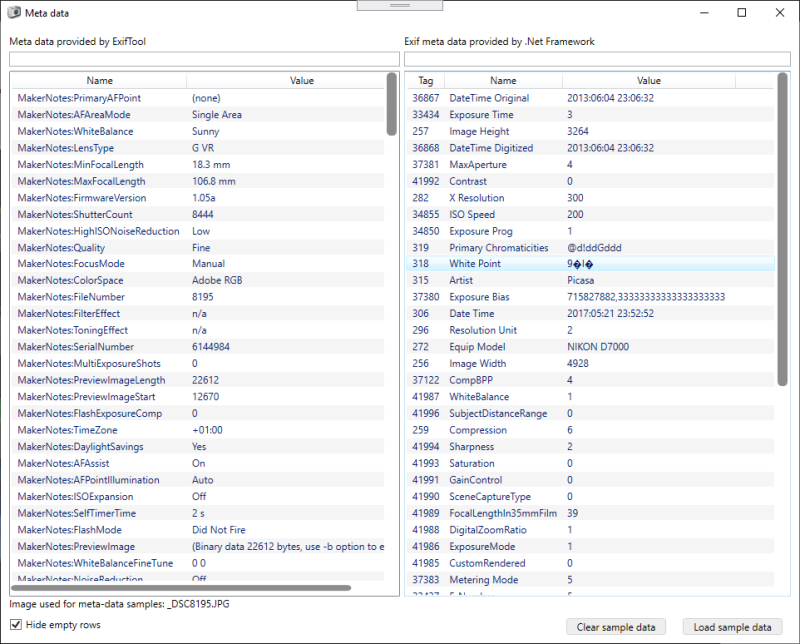
WIA-Loader allows using Phil Harvey's ExifTool to extract
metadata from pictures. This window shows which data can be accessed this way. You additionally
have the option to load sample data from any picture. These samples are then shown as examples
in the profile editor.
Tags
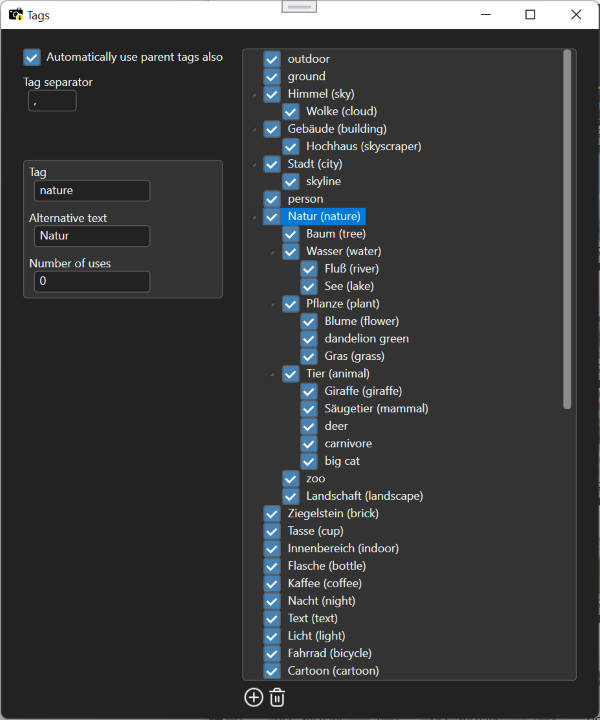
A structured keyword catalog can be created here. These keywords (tags) can then be assigned
to individual pictures in the main window via the context menu. Using the 'EXIFTool Changes'
import step, the keywords can then be written into the pictures' EXIF data during import.
Automatically include parent tags means, in the example shown above, that if you assign
the tag 'Giraffe' to a picture, it automatically also gets the tags 'Animal' and 'Nature' assigned.
If you create groups of tags whose name should not be automatically included, you can achieve
this by removing the small checkmark in front of the group's name.